
Dates Before Databases in Prior Lake
Choose the era before choosing a database. The backward trail for a Prior Lake address changes with the period, the street form, and the agency that created the record. The table groups the best documented routes. It does not promise an uninterrupted chain, because an entry can be missing, indexed under a different place name, or held only in an office or repository. Start with the row that matches the date you are testing, then record what kind of evidence each result supplies.
| Source and era | Years it covers | Where held | What it can show |
|---|---|---|---|
| Prior Lake plats, early census, church, and cemetery sources | 1850s through 1870s | Scott County Historical Society and county land sources | Township or land description, family and church links, early settlement context |
| Prior Lake deeds, tax records, maps, and newspapers | 1880 through 1939 | Land Records, Historical Society, and local collections | Transfers, farm or lot context, household and public-event references |
| Prior Lake census, 1944 map, plats, tax, permit, and church sources | 1940 through 1959 | Historical Society, county, and City routes | Postwar continuity, subdivision changes, and address forms |
| Prior Lake American, deeds, permits, and directory requests | 1960 through 1985 | Historical Society, MNHS, Land Records, and City sources | Suburban address trail, school, business, and public notices |
| Prior Lake RecordEASE, Property Information, SG3, and BS&A | 2018 to present, with system-specific older coverage | Scott County and City online or office routes | Current parcel context, recorded transfers, map layers, and permit events |
A Prior Lake street result from one period should not be carried into another without checking the date. For early Prior Lake research, an address may instead be a township, Spring Lake Village, rural route, lake description, subdivision, block/lot, or legal description. For later Prior Lake years, use the exact address and PID to join sources, then keep any unresolved interval visible.
Prior Lake Past Residents Start With Parcels
Begin the backward trail with Scott County Property Information. The official search accepts an address or a nine-digit PID. It can provide a legal description, building features, tax detail, valuation, tax statements, recorded-document leads, and a certificate-of-real-estate-value lead. The online display may show a primary taxpayer and is reference-only, updated weekly. Scott County says it does not verify ownership in that display.
Next open ScottGIS SG3. Parcel lines, municipal boundaries, ZIP layers, precincts, road relationships, and adjacent parcels help establish where the address sits. Preserve the present property address and a distinct mailing address when both appear. A Prior Lake postal city can cover City, township, SMSC, Savage, or Shakopee geography. The PID prefix and legal description are stronger jurisdiction clues than a postal label.
For historical Prior Lake tax or custom parcel material, use Scott County’s property-information request route or contact Property & Taxation at 952-496-8115. A request should name the address or PID, desired date, and public fields sought. That provides the office, phone, and defined-request fallback when the current screen does not reach the period needed.
Prior Lake Deed Index Boundary
RecordEASE is the main online land-record index for following earlier legal transfers. Scott County states that its computerized index begins in late 1966. The service covers parcel, document, related-document, plat, lien, and tract research, with stated imaging for Abstract/Torrens material, abstract book/page documents, all plats, tract pages, and certificates of title. It is not a combined search for tax, assessment, permit, GIS, or non-land information.
The official RecordEASE access screen shown below is the web entry to this part of the Prior Lake past-residents trail. For an earlier gap, contact Scott County Land Records at 200 4th Ave W, Shakopee, call 952-496-8150, or ask for in-office assistance with manual name, tract, book/page, plat, or microfiche research. The county’s live coverage statement is the right expectation for online searching; older project descriptions should not be merged into it.
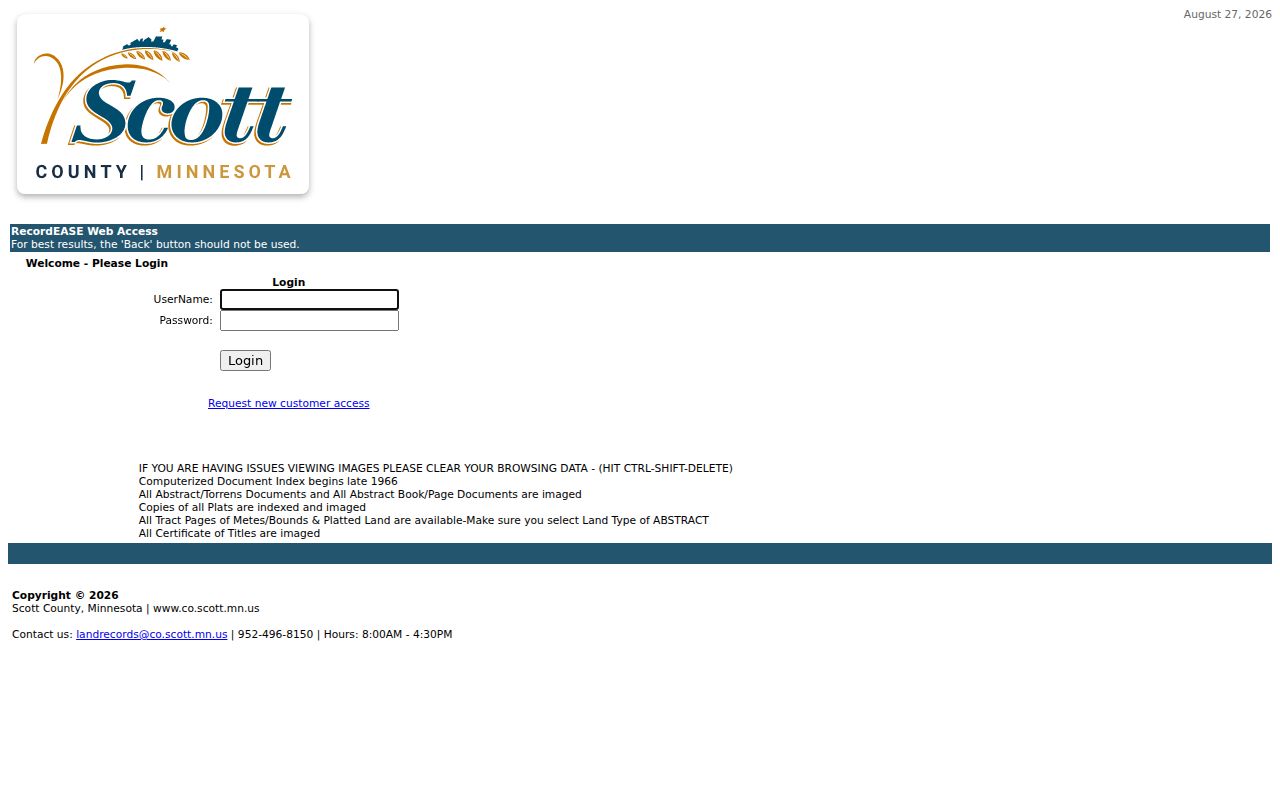
RecordEASE creates a document trail. It should be compared with the parcel’s legal description and date before connecting a named party to the specific Prior Lake address.
Trace a Prior Lake Deed Chain
A chain of title is the succession of recorded transfers for the same land. Work backward from the current parcel rather than treating every document shown for an address as a transfer. The right sequence connects the exact legal description, document number, date, and named parties. If an older deed uses a prior lot, block, or township form, locate the intervening plat or subdivision record before calling it the same place.
- Save the current PID, legal description, query date, and displayed property context from Property Information.
- Find the current or most recent transfer in RecordEASE, then capture its document number, type, recording date, grantor, grantee, and legal description.
- Search the outgoing grantor as a grantee in an earlier instrument to find that party’s prior acquisition, while checking the same land description.
- Repeat in reverse date order. Separate deeds from mortgages, releases, liens, certificates, and other related instruments.
- When the web index reaches its limit, ask Land Records about the pre-index book, tract, plat, or microfiche route for the same legal land.
- Grantor and grantee
- The grantor transfers an interest in land; the grantee receives the interest named in the recorded instrument.
- Chain of title
- A dated sequence of recorded land transfers for the same legal parcel, with gaps noted rather than assumed away.
- Legal description
- The recorded land description, such as a lot, block, plat, or metes-and-bounds wording; it is more durable than a changing street address.
- Criss-cross directory
- An address-arranged directory that may place a listed household or business at an address on its publication date.
The official Scott County parcel sales card illustrates the sort of dated instrument, grantor, grantee, number, and recording detail that should be preserved.
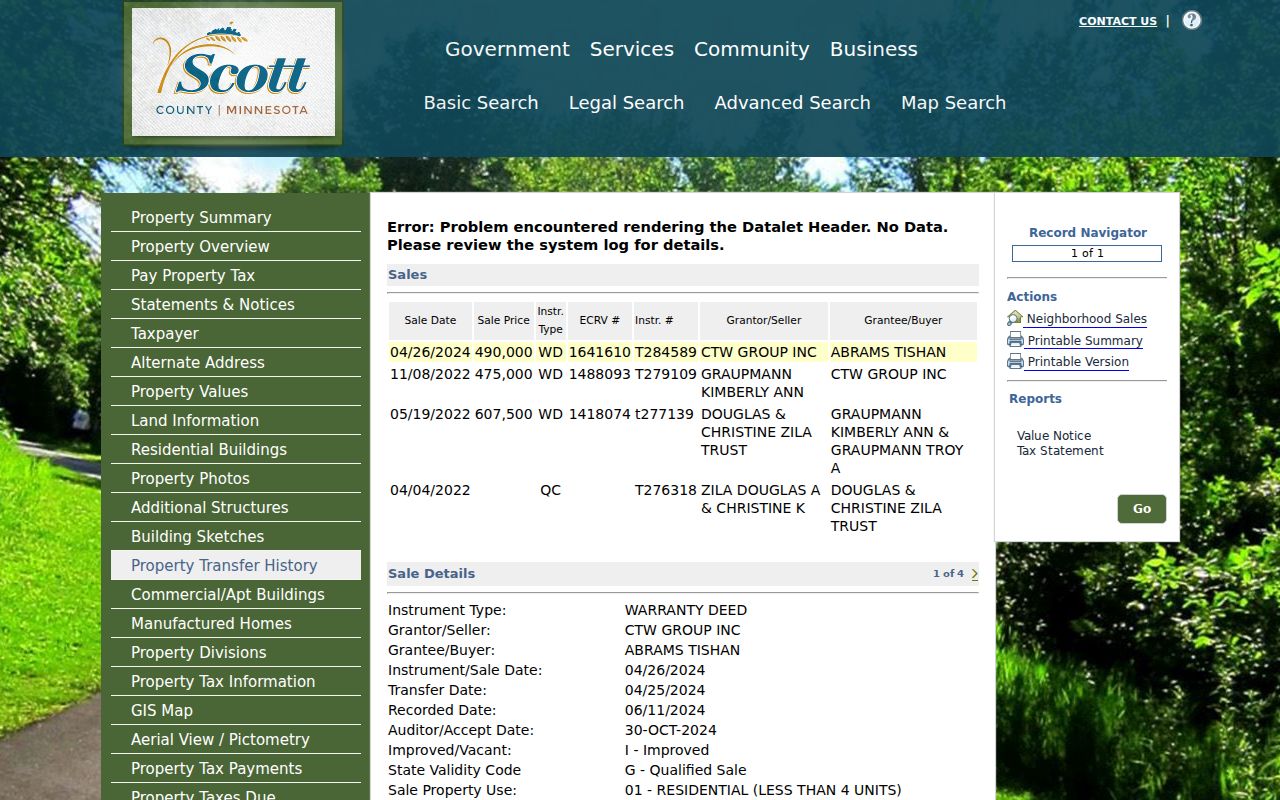
Those fields support a transfer timeline. They do not, by themselves, establish an uninterrupted household history at the property.
Early Prior Lake Address Forms
Before 1900, search the land and place names that existed at the time. Spring Lake Village was platted in 1852 and surveyed in 1857. The railroad arrived in 1871, when the community took the Prior Lake name. Older records may use Spring Lake Village, Spring Lake Township, a lake or farm description, a rural route, or a legal land reference. Scott County separated from western Dakota County in 1853, and Shakopee became the county seat about a year later, another reason early material may sit in county-centered series.
The Scott County Historical Society has Prior Lake county maps from 1874, 1880, 1898, 1913, and 1944; plat maps from 1854 through 1974; church registers; cemetery plot maps; obituaries; census and town-history material; and family files. The 1863 cemetery survey and 1897 church are particularly useful genealogy pivots when a modern street form is unhelpful. Ask the Society for a named map sheet, source date, and whether a card index points to a full source image.
No official Prior Lake Sanborn run was located. The Historical Society lists Sanborn examples for Shakopee, Belle Plaine, and Jordan instead. Treat that as a located gap, then ask the Historical Society, MNHS, or Library of Congress whether a Prior Lake or Spring Lake Village sheet exists rather than using a different city’s map as a substitute.
Note: A historical place name is a search term tied to a date, not proof that every past resident used the same label.
Prior Lake Newspaper Years
For 1960 forward, the Prior Lake American can bridge some Prior Lake address gaps. The weekly paper began in October 1960 and continues, while the Scott County Historical Society lists microfilm for 1881, 1916, 1917, 1925, and 1965 through 2014. The listed gaps remain gaps. Ask about other issues or titles rather than treating a missing microfilm year as a negative finding. MNHS says post-1977 issues are mostly subject to copyright and accessible at the Gale Family Library under its rules.
Search one Prior Lake time window at a time for public notices, land sales, school material, church events, civic groups, obituaries, wedding announcements, and business advertising. Copy the exact wording, issue date, page, and surrounding context. Newspaper OCR and anniversary pieces can repeat spelling or street errors. The city’s growth from 848 in 1960 to 27,617 in the 2020 Census helps explain why later records are more likely to use subdivisions, permits, and a changed parcel pattern.
For a pre-digital Prior Lake household lead, the Historical Society’s obituary cards, church registers, and cemetery maps can help connect a surname, family cluster, and date. They are valuable human-use sources for family history, but none should be turned into a current-address claim.
Prior Lake Household Pairing
Legal owners are only one layer of a place history. To test who lived here before, pair the transfer chain with a directory, census, newspaper, cemetery, church, or obituary source that is dated to the same interval. No complete official Prior Lake city-directory run was located. The responsible fallback is a targeted request to the Historical Society or the MNHS City Directory Search Request, which can search one person or business in up to five years of one city’s directory or telephone books for a $5 processing fee.
Use this compact sequence: address or legal description, then deed date, then a directory or newspaper date near that transfer, then the matching census or family source when the time period supports it. Preserve an address spelling or township label exactly as printed. The historical collections themselves are described on the Prior Lake Directory Book page, while the street-wide current record path belongs on the Street Directory page.
The MNHS People Search image below shows the statewide filters that can narrow birth, death, census, veterans’ graves, and related historical leads. Compare any index result with an image or county source where available, because MNHS notes coverage and transcription limits.
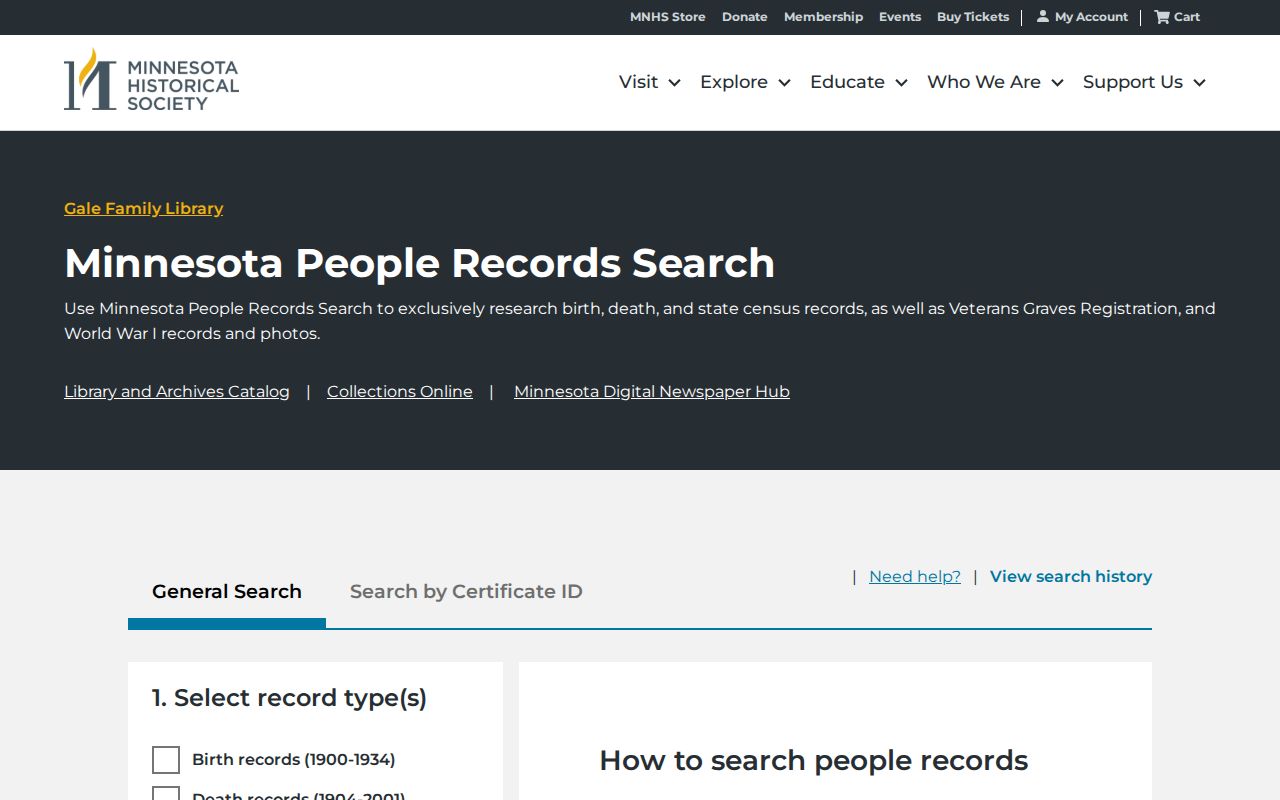
That search is a way to locate a record category. It does not convert a historical index entry into a complete address timeline.
Prior Lake Evidence Ledger
Keep a small ledger for each past-residents search: date, address wording, PID or legal description, named person or entity, role, source, record number or page, and confidence. The role matters. A deed establishes a legal conveyance. A tax display establishes an administrative taxpayer field for a payable year. A directory gives a listed address on publication date. A newspaper gives a dated public mention. A permit gives a project event. A census gives an enumerated household under its own geography.
Use a high-confidence label only when at least two independent identifiers agree, such as the legal parcel and a dated family source. Preserve conflicting names, dates, or addresses as unresolved. If the legal holder is a trust, estate, corporation, or multiple grantees, retain that exact form. A modern prior-residents result can be incomplete because the source was created for a limited administrative purpose, not as a full account of a place.
The MNHS birth-index guidance shown here is a reminder that historical indexes have stated coverage and access limits. For a vital-record request, use the official MDH or Scott County route and its eligibility rules rather than inferring a relationship from an index alone.
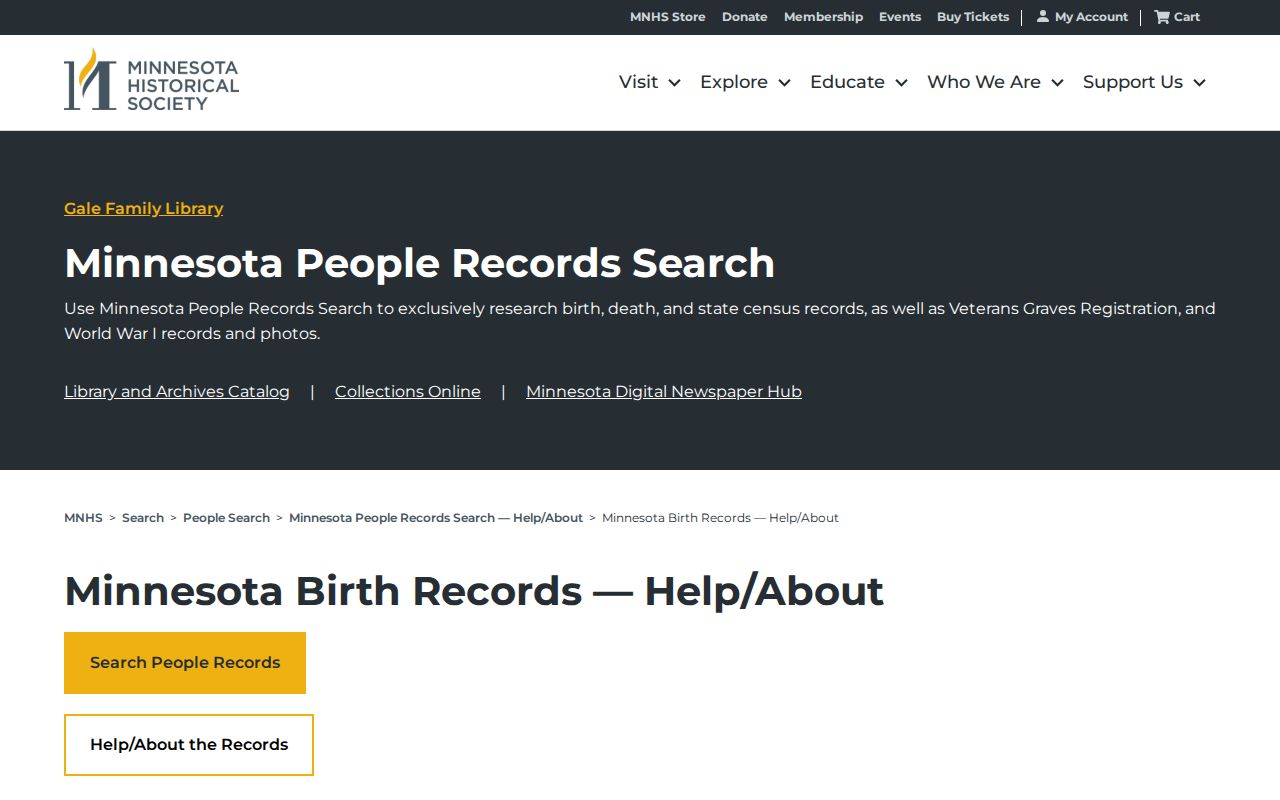
A precise source note makes correction possible when a later record changes the identification or fills a gap.
Private Details and Past Residents
House history is a lawful personal research task, not a reason to assemble a dossier on a living person. Do not try to reverse a Safe at Home address, reproduce protected voter data, obtain private driver information, or work around sealed, expunged, confidential, or nonpublic records. A missing current result may reflect privacy, coverage, identity, indexing, retention, or a changed classification. Preserve it as “not located in the searched source” rather than making a larger claim.
For a defined public record not available online, ask the appropriate custodian for existing public fields and a reasonable date range. Land Records, Property & Taxation, City permits, City Hall, the Historical Society, and MNHS offer distinct office, phone, mail, email, in-person, or archival routes. Minn. Stat. ch. 13 requires agencies to classify data and allows a custodian to identify the law that supports a denial or redaction.
Lawful use. Use Prior Lake history sources for family research, estate and heir questions, personal curiosity, or record correction. Do not use information found here to stalk, harass, track, intimidate, or harm anyone.